February 25, 2026
In my mind, Eldernell is synonymous with owls, raptors and if you’re lucky Cranes. It is a wild, remote spot and if the wind is blowing across the open expanse of the Nene flood plane it can be very cold.
Luckily, on the morning of our visit it was dry and not very windy but the recent heavy rain had resulted in the flood plane doing its job and the view from the flood bank was 100% water. Hardly any bushes were showing and the watercourse at the foot of the flood bank had combined itself with the open water of the flood plane. The only manmade objects showing above the water were the tops of a few gates and cattle pounds.
Normally there is a patchwork of ditches and bushes along either side with lots of habitat for small birds, voles and amphibians but none were showing and hence the food source for the birds was not there on the flood plane side of the flood bank.
We decided to concentrate on the landward side where there are plenty of trees and shrubs and this is where experience tells us the owls are normally to be found. Tawny owls are nocturnal and Barn owls normally prefer early morning or late evening for their daylight hunting. We were not too surprised that neither were showing. However, Short-eared owls do hunt in daylight. They are about the same size as Tawny owls but have long slender wings whereas Tawny owls are altogether more stocky. Long-eared owls are regularly seen at Eldernell but they are nocturnal and are only seen in daylight when they are roosting. In this state they are resting and rarely move so they are hard to see unless you are lucky enough to have one pointed out to you by a sharp eyed birder. All owls tend to be very faithful to their roosting sites so once found there is a much better chance of looking in the right tree or bush but even then their plumage provides excellent camouflage. Short-eared and Long-eared owls are about the same size as each other and have similar plumage. The key difference is the eye colour. Short-ears have yellow eyes, Long-ears have orange eyes. Since their eyes are quite large this is a good way to tell the difference.

Long-eared owls is a slight misnomer as what you see and think are ears are in fact feathery tufts which are normally flat but can be raised when the bird is alarmed or displaying.
Little owls are as their name suggests smaller and they can be seen at all times of the day. Like most raptors, owls spend a lot of time resting and watching and comparatively little me is spent hunting. Little owls like to sit on branches adjacent to the trunk of the tree, which is another challenge for birders making them hard to spot unless they move.
Unfortunately, we didn’t see owls of any variety on this visit. Maybe another day.
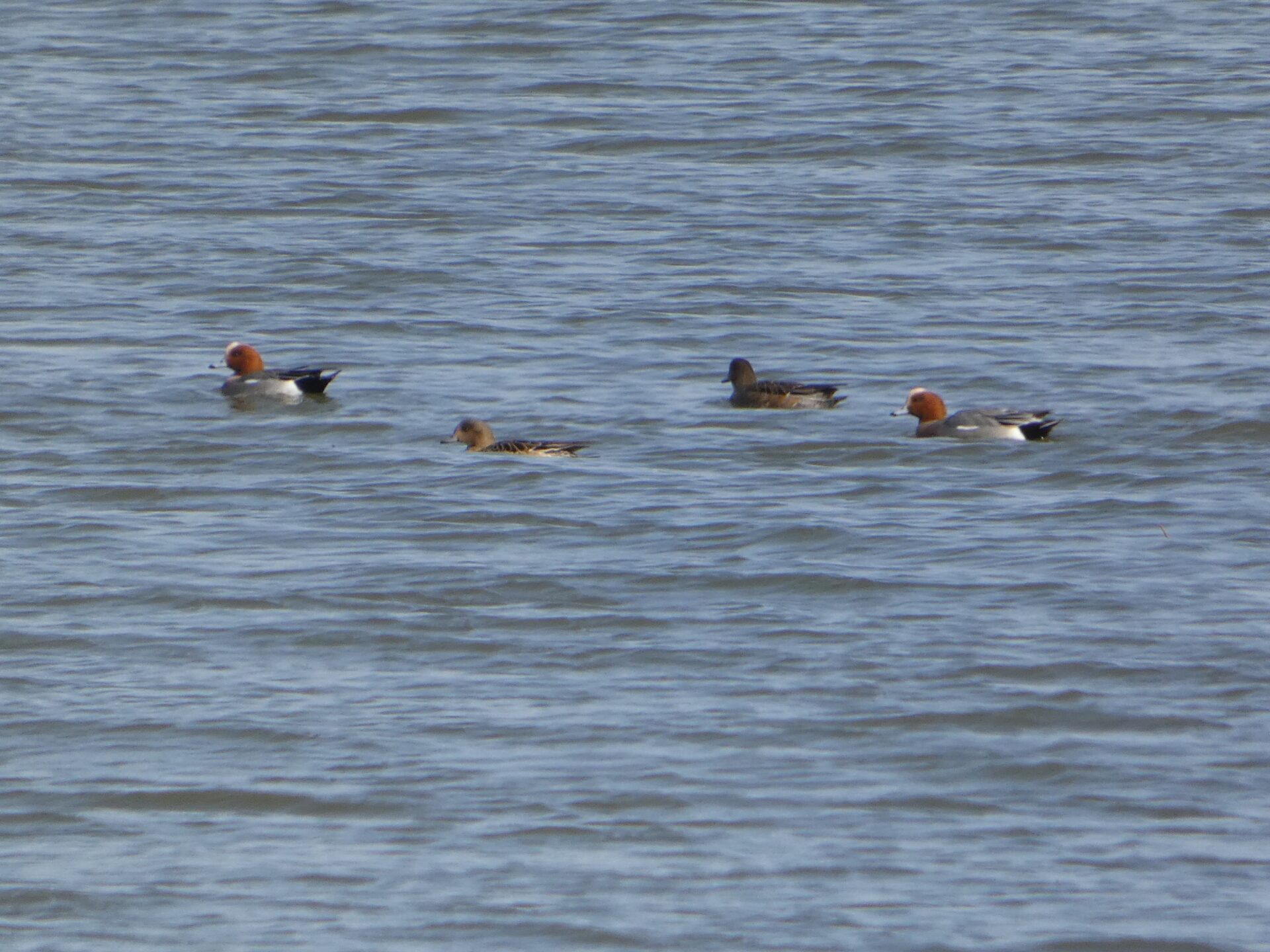
There were plenty of water fowl on the flood. Wigeon were present in good numbers and could be heard whistling. There were also Shoveler, three Shelducks, Mute swans, a single Whopper swan, Greylag, Egyptian and Canada geese, Coot and Moorhen.
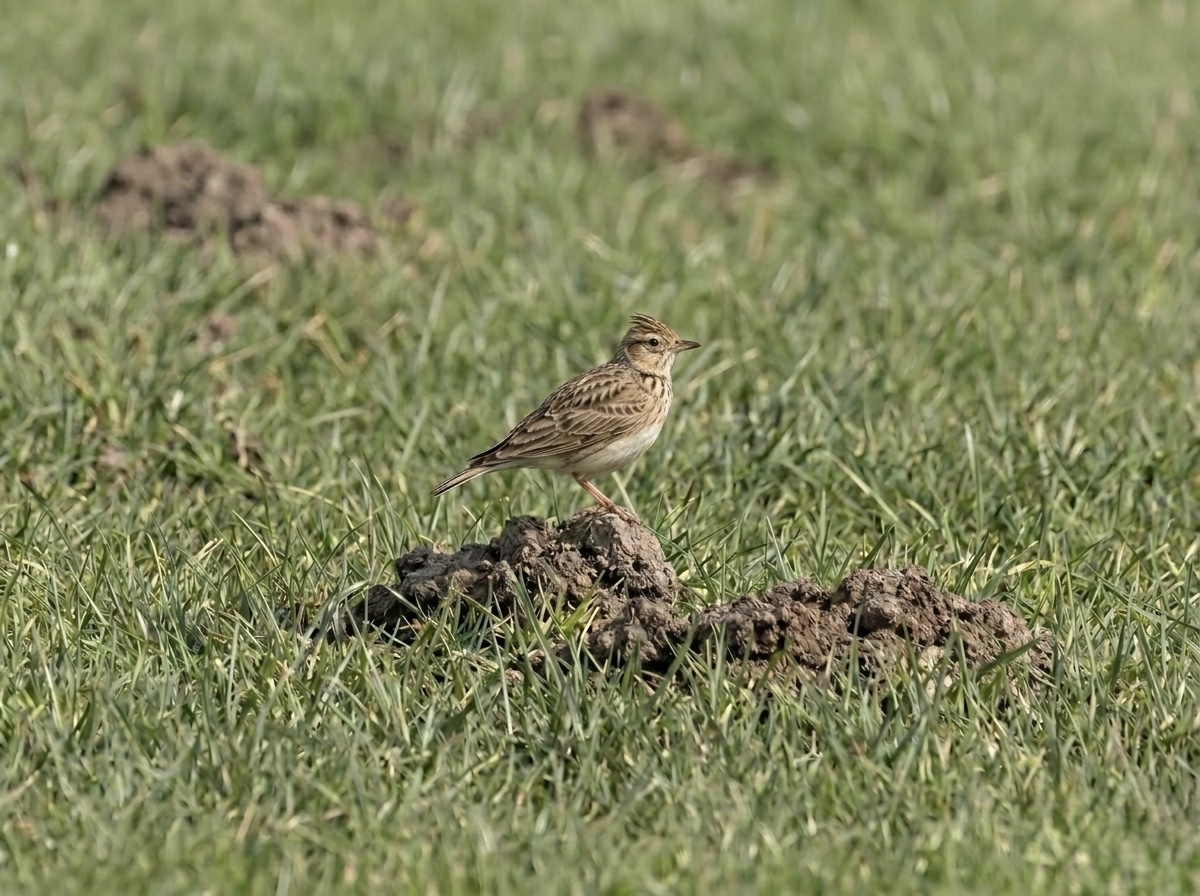
In the bushes we saw a Reed Bunting, a House Sparrow, and on the path we saw a possible Goldfich, a Pied Wagtail, while in the air a Sky Lark was hovering and singing.
A pair of Red Kites entertained us with good views as they flew over the path.
The star birds were a pair of Common Cranes stand on the path at a gate. We were able to see their distinctive bustles but we were too far away to make out the red markings on their crowns. Cranes are the tallest birds native to the British Isles which is clear when they are standing next to geese.
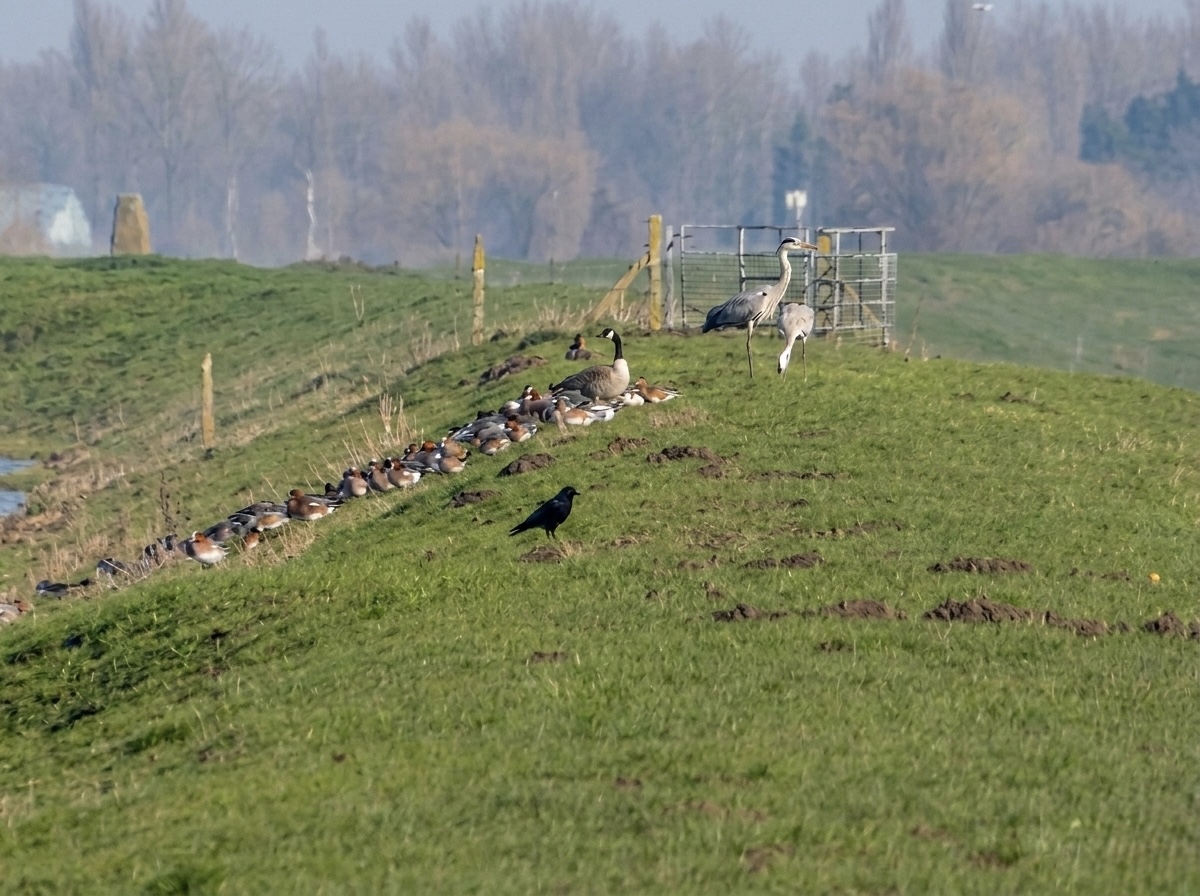
Cranes are very shy and normally seek reed beds or areas with dense undergrowth to rest in. We were lucky so see these two in the open even at distance.
In East Anglia we have to get used to winter flooding which significantly changes the habitat and this was such a day. However, there is always good company and something special to see.
Widgeon Common Crane Great Crested Grebe Skylark