May 27, 2026
Eight members joined our trip to this popular reserve where in springtime we usually find a good range of passerine and wetland birds often with a few raptors for good measure. Our April visit to RSPB Lakenheath had been sunny and we were in luck with the fine weather holding for this trip just a few miles further east. In fact, the preceding days had been if anything too fine with temperatures in the thirties but the 27th was forecast to be mid-twenties with light wind, which is altogether more suitable for bird watching.
Lackford Lakes is a reserve that is lucky enough to hold Nightingales and so we opened the car windows as we drove along the approach track in the hope of catching their unmistakeable song. However, this time we were unlucky. Sometimes they prefer to nest in the bushes in the meadow across the track from the visitor centre and I have found them in the farmland beyond the sailing club.
The first footpath from the visitor centre runs alongside the sailing lake and we spotted Canada and Egyptian geese on the pontoons at the sailing club. A Chiffchaff was singing at full volume and Wrens and Cetti warblers joined in the chorus as we walked alongside the lake. Tufted duck, Greylag geese, Mallard and a few Gadwall were present and the inevitable Coot were busy in the reeds at the fringes. Black-headed gulls and Common Terns were circling while a Grey Heron kept watch from it’s perch on the opposite bank.
To avoid another sizeable group of visitors, we first went in to Bernard’s Hide, which looks out over water where perches have been placed to attract Kingfishers. You can guess what I’m going to say next, because none posed for us to take pictures this time although, to be fair, they have done on previous visits. A pair of mute swans came by and gave us a chance to take some cute shots of their family of six cygnets.
A blach-headed gull was sitting on what appeared to be a nest on the top of a stump of a willow tree, which had been pollarded so that lots of shoots were protruding. We agreed it looked rather uncomfortable so good luck to that gull.

Returning to what is normally the first hide, Paul’s Hide, which overlooks a piece of water called the Slough, we saw a good selection of ducks, geese and water birds. Common terns and Black-headed gulls were nesting on a raft while Shelduck, Oystercatcher, Lapwing, Mallard, Gadwall, Tufted duck, Coot, Moorhen, Greylag geese were all spotted.
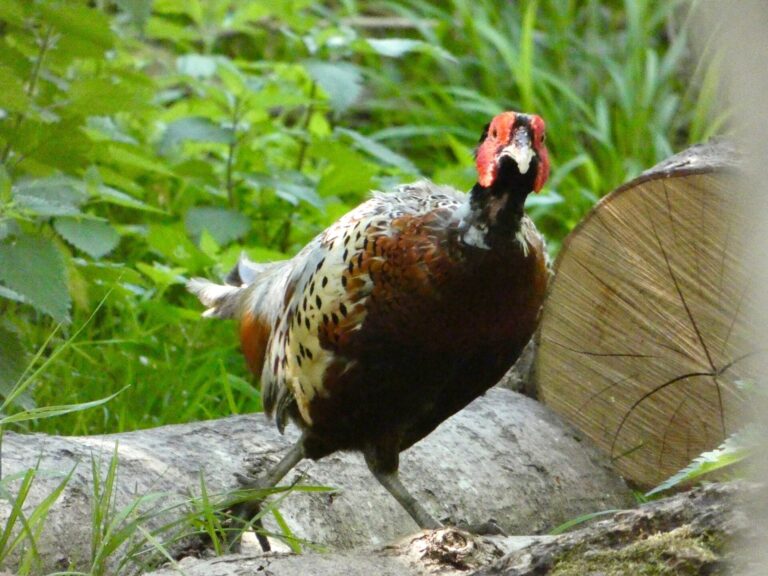
We walked on past the Double-decker hide into the Ash Carr where photographers often put food on the large fallen trunk to attract the Nuthatch, Marsh Tits and other woodland birds. Some of our group saw Nuthatch but I only managed to see a male Pheasant. I suspect that, like many other reserves, SWT may have introduced a policy of not feeding birds in ways that may result in the spread of viruses.
We passed on through the woods with the sound of chain saws coming from the Mill Deep lake where Fuller’s Mill Hide used to be. At Bess’s Hide on Long Reach we found more of the same water fowl and gulls.
Cuckoo were calling most of the morning but we didn’t get any close views. It seems to have been a good year for cuckoos with most of our local reserves reporting numbers up. We also noted large numbers of damsel flies and dragon flies at most locations.
Reed warbler were heard in the reed beds all round the reserve. Sally heard a Bittern and Melvyn had a brief view of a Kingfisher.
Robin, Chaffinch, Starling, Blackbirds, Wood pigeon and Crows were with us most of the morning. Blue Tit and Long-tailed Tit were seen in several places.
A quick look at Hawker Pool and all seemed quiet so we decided to retrace our footsteps to the cars and have our lunch.
After lunch, we made the short trip in the cars to the very different habitat of Cavenham Heath. Here we saw two, possibly three, Stone Curlews darting to and fro in the heather.


There were also five Common Curlew, a male Stonechat, several Skylarks, a few Carrion Crows, a male Kestrel and other birds which the heat haze and distance made it not possible to identify.
In previous years we have seen Wheatear at this site but we may have been a little too late for these birds that usually pass through on their way to upland areas where they breed.
A successful days birding was enjoyed by all.

Ring-necked pheasant 
Stone-curlew 
Nuthatch 
Stonechat