Date: 24/04/24
Nine members of BG2 met at Lakenheath on a cold morning hoping that the recently arrived migrant warblers and cuckoos would find their voices and give us a bit of a show.
The visitor centre was functioning as usual but the office accommodation is being extensively repaired following serious flood damage. However, the welcome from John the volunteer was as warm as ever as he told us of the possibility of seeing Bittern, Marsh Harrier, Bearded Tits, Warblers, Cuckoos, Cranes etc. He did of course tell us that none of these could be guaranteed! Such is life.

The first bird spotted was a male reed bunting perched in the willow at the poolside immediately behind the visitor centre. The male birds have black heads, white edges to their tails and are a little larger than a house sparrow. The females have different head colour being brown with a distinct face pattern. As the name suggests, they are often found near water or boggy places but are also frequent visitors to gardens in St Ives and farmland margins.
The feeders by the visitor centre were popular with Blue Tits, Great Tits and Robins and in the pool were a Moorhen and Coots with several very small chicks. Coot chicks have plum red reads when they are tiny and look very cute. Coots are happy to be on water whereas Moorhens are more water edge foragers and are rarely seen a long way from land. Both these waterbirds have huge feet for the size of their body.

Coot and Moorhen are members of the Rail family which includes Water Rail, Corncrake, Spotted Crake and several other rare crakes and gallinules. Of these all, except the Coot and Moorhen, are very secretive and many are nocturnal. As they live in marshes, their presence is only shown by calls in the middle of the night. They are rarely seen.
Moving on, we walked up the track between the railway and the poplar plantation. The rough ground alongside the railway is usually home to warblers such as Chiffchaff and Whitethroat but in the cold breeze they were not showing. A solitary Cormorant flew over.

We reached the first large reedbed where the screen gave us welcome shelter. This marsh has quite a large area of open water where we saw more Coot with chicks, Moorhen and we saw and heard Little Grebe. These water birds are the smallest of our grebes and are slightly smaller than Moorhen. In breeding plumage they have red necks and a noticeable white patch at the base of their beak. Their local name is Dabchick which seems to fit their dumpy rounded appearance which reminds some people of a powder puff.
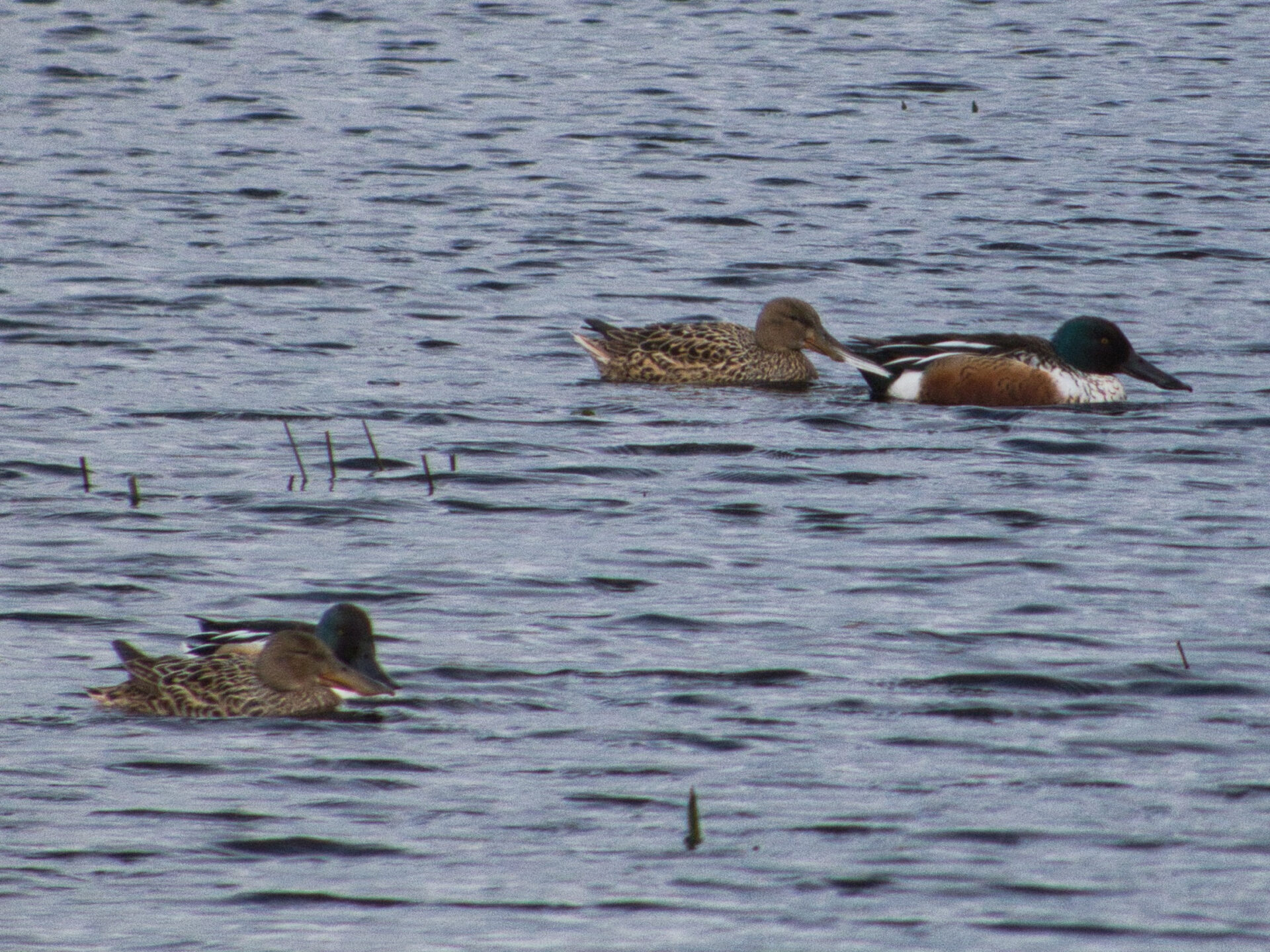
Other birds on the reedbed lake were several pairs of Shoveler ducks, One pair of Tufted ducks, one pair of Gadwall ducks and a pair of Great Crested Grebe. While we watched Greylag geese flew in and out and Canada geese were on view.
While we watched the reed bed, a male Marsh Harrier swooped overhead. The male birds have brown and white wings with black wingtips. The females, which are larger, are darker brown all over with a cream head. Marsh Harriers are quite rare nationally, but relatively common in the gravel pits and reed beds of East Anglia. Like other harriers, they perform elaborate display flights and the males pass food to the females in mid-air.

As we followed the path further up the reserve, we heard a rasping call coming from the reeds along the ditch. Reed Warblers and Sedge Warblers have very similar songs and we listened hard to decide what we thought this was. Our guess that it was a Reed Warbler was supported by the Merlin app that many of us use. The Sedge Warbler is slightly more manic than the Reed Warbler and they are easily confused. Reed Warblers tend to stay out of sight low down near the roots of the reeds whereas Sedge Warblers fairly often sit on top of brambles singing in full view. Once seen they are quite easy to identify as the Sedge Warbler has a prominent white (supercilium) stripe above its eye.
Our next stop was the Reedbed Hide, often a good spot for seeing Kingfishers and popular with photographers. In the past, we have seen Cormorant swallowing fish or eels that look too big for them but none of these glutinous displays today.
While in the Reedbed Hide we were treated to the song of a cuckoo not far away, which sounded like it was coming from the poplar trees towards the River Little Ouse. We walked past where the cuckoo had been but it decided it had had enough singing and we didn’t hear it again.
The end of the reserve looks out over a wild area called Joist Fen and once again we were glad of the shelter. We combed the fen with our binoculars, especially the areas where we knew Crane might be found but only a single Great White Egret and several pairs of noisy Greylag geese were seen.
This is also the area where the Bittern nest but despite the reports of 17 boomers which shows that the site is doing very well, we heard none and saw no flights.
As lunchtime was approaching, we walked back to the visitor centre via the river bank. This raised flood defence provides very good views down into the reserve marshes and the adjacent meadows. However, the wind was blowing strongly and the cold drizzle became unpleasant.
In the event, most of our party decided to call it a day and return home at this point including those who had afternoon appointments.
Sharon and I decided to eat our sandwiches in the visitor centre where we talked to the warden who was also having his lunch. He was telling us about a female Mallard that had been raised as an orphan by a local nature lover. It was one of a family of 5 or 6 and in due course they were given to the RSPB to attempt to release them into the wild. Most of them re-wilded successfully but one stayed around the visitor centre and often comes into the building when the door is left open remaining stubbornly tame.
While he was telling us this story, we spotted a stoat run across the decking and as we discussed it suddenly the warden jumped up and said “there’s a Nightingale singing”.
We followed him outside and sure enough there was the unmistakable song of the Nightingale coming from a bush not 10m away. Once heard, the Nightingale song is never forgotten, containing a crazy mix of fluty notes, clacks and wheezes all at high volume.
We didn’t get to see the bird itself as it was singing from the preferred location deep inside the cover of the willow bush.
What a great end to the trip and a shame that many of our colleagues missed it.
Coot and chicks 
Gadwall 
Goldfinch 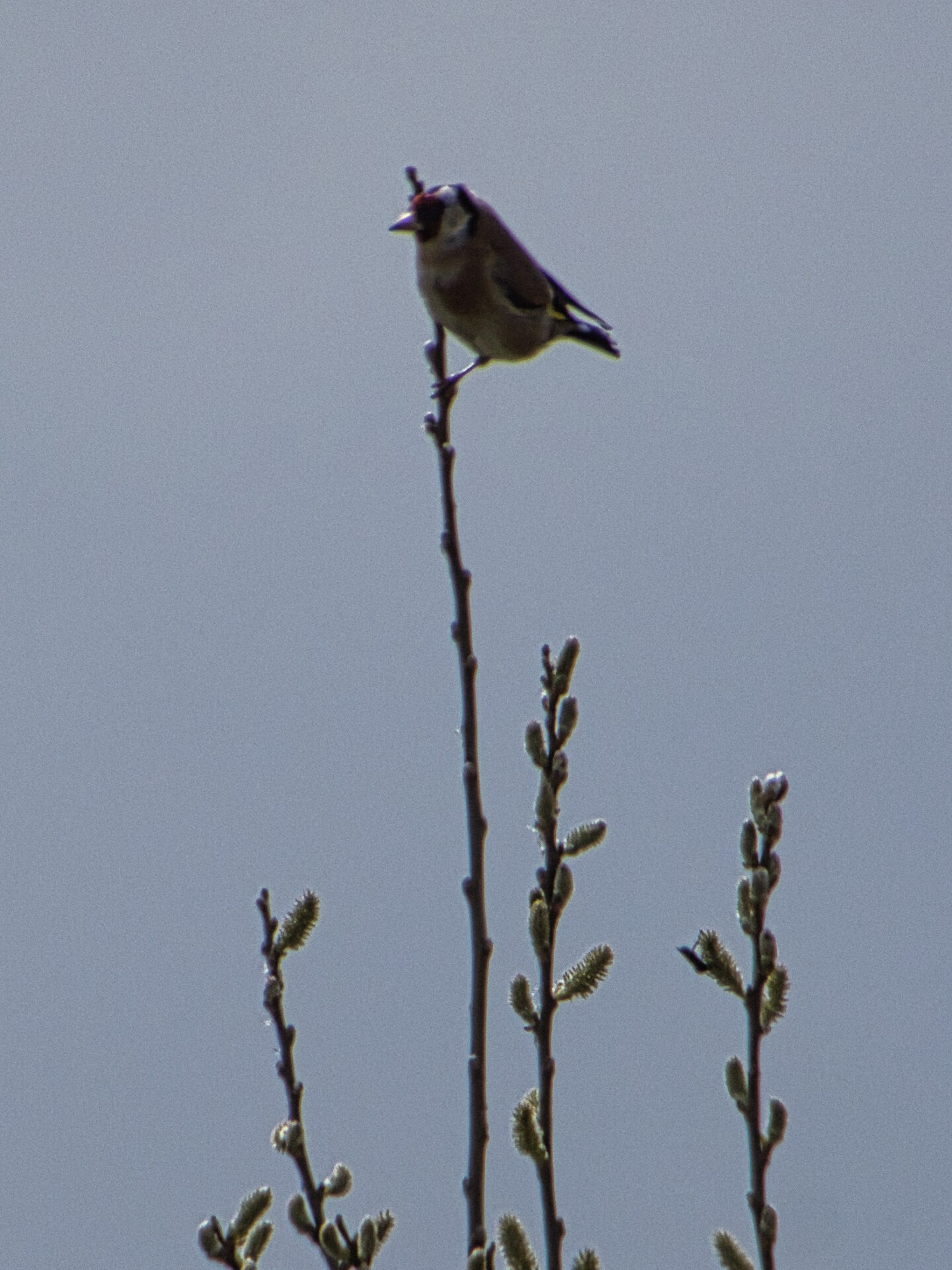
Goldfinch 
Great crested grebe 
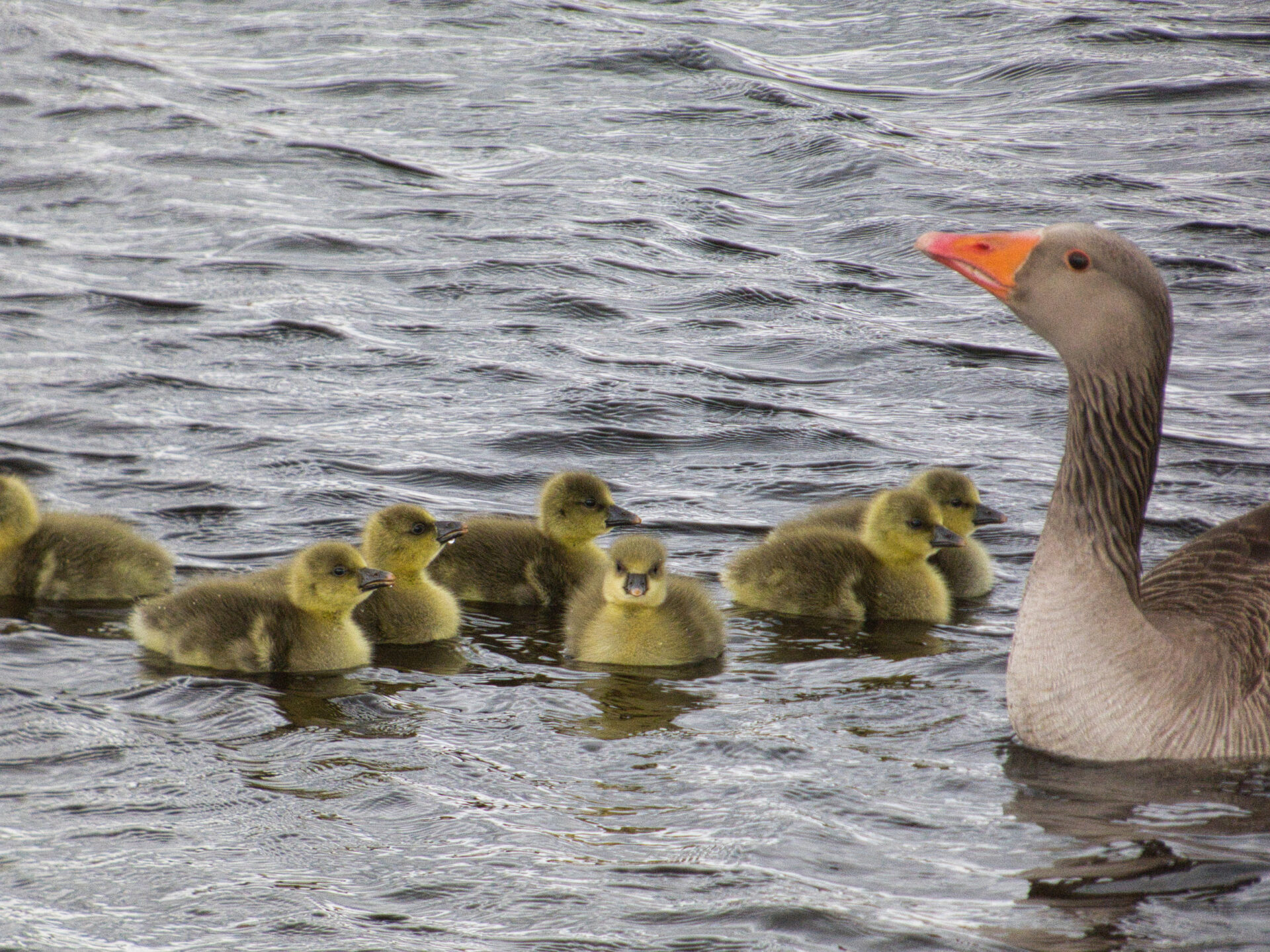
Great tit Greylag goose and chicks Little grebe 
Pheasant Reed bunting Shoveller Tufted ducks